
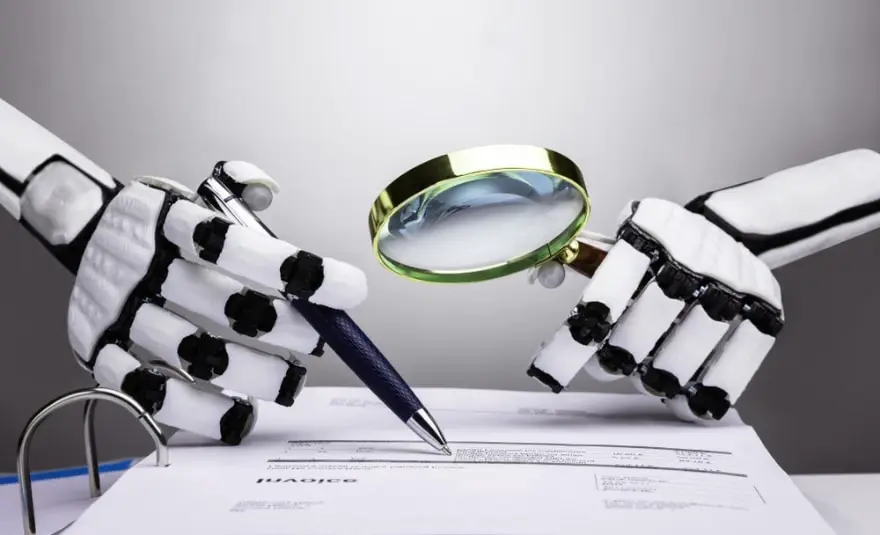
The fluorescent lights of the partner’s office and the sterile white glow of the hospital corridor share a common secret: exhaustion. For decades, the pillars of our most respected professions—law and medicine—have been built on a foundation of burnout. The junior associate drowning in due diligence at 3 AM and the primary care physician spending their evenings "pajama charting" are victims of the same inefficiency. They are highly trained experts reduced to high-priced scribes.
But 2025 has brought a quiet revolution. It isn’t the noisy, apocalyptic "robots replacing us" narrative of early sci-fi. It’s subtler, faster, and infinitely more competent. We are witnessing the rise of the AI Copilot—a digital entity that claims it can draft a watertight non-disclosure agreement or transcribe a complex patient encounter with the precision of a ten-year veteran.
The question, however, is no longer canthey do it. The technology exists. The real question—the one that keeps general counsels and hospital administrators up at night—is can we trust them?Can an algorithm truly navigate the nuance of a liability clause or the subtlety of a patient’s hesitation?
Let’s be honest: the stakes here are terrifyingly high. A hallucinated fact in a blog post is embarrassing; a hallucinated clause in a merger agreement is actionable negligence. A missed allergy in a medical note is malpractice.
This is your briefing on the reality of AI accuracy in 2025.
The Legal Landscape: From Billable Hours to Instant Drafts
The legal profession has long relied on a business model that essentially sells time. But clients don't buy time; they buy certainty. For years, the industry scoffed at the idea that software could replicate the "bespoke" nature of legal drafting. That skepticism is rapidly evaporating.
The Accuracy Audit: AI vs. The Associate
In September 2025, a landmark study by LegalBenchmarks.aidropped a bombshell on the industry. The study compared human lawyers against top-tier AI models in drafting commercial contracts. The results were not just close; they were a changing of the guard.
The top-performing AI model, Google’s Gemini 2.5 Pro, achieved a reliability rating of 73.3%. The human lawyers? They averaged 70%.
Let that sink in. In a blind test, the machine was statistically more reliable at producing a first draft than the human professional. The study noted that AI tools were particularly adept at flagging risks that humans missed entirely—identifying unenforceable penalty clauses in 83% of test cases, while human lawyers frequently glossed over them.
The "Hallucination" Hangover
However, we cannot talk about legal AI without addressing the elephant in the courtroom: Hallucinations. We all remember the infamous Mata v. Aviancacase, where a lawyer used ChatGPT to write a brief, only to have the AI invent entirely fictitious case law. It was a humiliation that rippled through the global legal community.
While 2025’s specialized tools have largely solved the "fake case" problem through a process called Retrieval-Augmented Generation (RAG)—which forces the AI to only cite from a verified database of laws—the risk has shifted. The danger now isn't that the AI will invent a case, but that it will subtly misinterpret a validone.
Tools like Harveyand Spellbookare mitigating this by acting less like "generators" and more like "guardrails." They don't just write; they cross-reference. When you ask Spellbook to draft a "friendly" indemnification clause, it doesn't guess. It pulls from a library of pre-approved, "market-standard" clauses that have survived court challenges before.
The Rise of the "Playbook"
The true power of AI in law isn't creativity; it's compliance. In-house legal teams are now using platforms like Ironcladto enforce company "playbooks."
Imagine a tired junior lawyer reviewing their 50th Non-Disclosure Agreement (NDA) of the day. Their attention wavers. They might miss that the counterparty changed "New York Law" to "Cayman Islands Law." An AI never gets tired. It never skims. It checks every single word against the company's digital playbook and flags the deviation instantly.
In this context, AI is not replacing the lawyer's judgment; it is protecting the lawyer from their own fatigue.
The Medical Frontier: Notes, Not Diagnoses
If a bad contract costs money, a bad medical note costs lives. The pressure on healthcare providers is immense, with studies showing that for every hour a doctor spends with a patient, they spend two hours on paperwork. This "desktop medicine" is the leading cause of physician burnout.
Enter Ambient Clinical Intelligence.
The "Invisible" Scribe
Unlike the legal world, where the AI is active (drafting), in medicine, the AI is passive (listening). Tools like Nuance DAX(owned by Microsoft), Freed, and DeepScribedo not require the doctor to dictate. Instead, the doctor simply has a conversation with the patient.
The phone sits on the desk, listening. The AI separates the speakers (diarization), filters out the small talk about the weather, and extracts the clinical pearls. By the time the patient leaves the room, a structured SOAP note(Subjective, Objective, Assessment, Plan) is waiting in the Electronic Health Record (EHR), ready for signature.
The Accuracy Reality Check
How accurate are they? Recent data suggests these tools have hit a "tipping point" of usability. A study involving Mass General Brighamshowed that ambient documentation reduced burnout by over 20% and was embraced by thousands of providers.
But "embraced" does not mean "perfect." The error rate for top-tier medical AI scribes hovers around 1-3%for critical omissions or hallucinations.
In a general practice setting, an error might be minor—recording a patient's self-reported pain level as 6 instead of 7. But in complex oncology or cardiology cases, the nuance matters. Did the patient say they have chest pain "sometimes when running" or "every time I run"? The AI can occasionally struggle with these ambiguities, especially if the audio quality is poor or the patient has a heavy accent.
The Privacy Paradox
Patients, surprisingly, are warming up to the idea. A survey by UC Davis Healthfound that nearly half of patients felt AI scribes were a "good solution" because it freed the doctor from staring at the computer screen.
The trade-off is privacy. While these systems are HIPAA-compliant and often do not store audio permanently, the idea of a "listening device" in the exam room requires a new level of trust. The best tools, like Nabala, emphasize that the AI is a "transient" processor—it hears, transcribes, and forgets.
The Head-to-Head: Legal vs. Medical AI
To understand where we stand, we must look at the data side-by-side. The requirements for "accuracy" differ wildly between a courtroom and an operating theater.
Feature | Legal AI (Contract Drafting) | Medical AI (Clinical Notes) |
Primary Goal | Risk mitigation & speed. | Burnout reduction & patient focus. |
Leading Tools | ||
Accuracy Metric | ~73% reliability(first draft). | ~96% usability(requires minor edits). |
Main Risk | "Hallucinating" non-existent laws. | "Omitting" critical patient symptoms. |
Human Role | The Architect:Defines the structure, reviews the logic. | The Editor:Verifies the facts, signs the note. |
Time Savings | Reduces drafting time by 40-60%. | Reduces documentation time by 50-70%. |
The "Human-in-the-Loop" Mandate
Here is the kicker: Neither industry is ready for "autopilot." We are firmly in the era of the Copilot.
The illusion of AI is that it "understands" what it is writing. It does not. A Large Language Model (LLM) predicts the next statistically probable word. It does not know that a "breach of contract" is bad; it just knows that those words often appear together in negative contexts. It does not know that "hypertension" is a risk factor for stroke; it just knows they are correlated in its training data.
This lack of semantic understanding means that while AI can draft, it cannot advise.
The New Workflow
In 2025, the most successful lawyers and doctors have shifted their workflow. They no longer write from scratch.
- The Lawyer:Uses AI to generate the "boilerplate"—the standard 80% of the contract—and spends their high-billable hours negotiating the contentious 20% that actually matters to the client.
- The Doctor:Uses AI to capture the "data"—the symptoms, the history—and spends their mental energy on the "diagnosis"—connecting the dots that the AI might miss.
This shift is not about laziness; it's about cognitive load. By offloading the transcription and drafting to the machine, the human professional is freed to do what humans do best: think critically, show empathy, and make judgment calls.
The Verdict
So, can AI write legal contracts and medical notes accurately?
Yes.In fact, in 2025, it can often do so with greater grammatical precision and structural consistency than a sleep-deprived human.
But "accurately" is not the same as "safely." The AI is a Lamborghini with a blindfold. It has immense power and speed, but it has no idea where it is going. It requires a driver—a human expert—to steer it, to slam the brakes when it hallucinates, and to navigate the complex ethical intersections that no algorithm can comprehend.
The professionals who will thrive in this new era are not the ones who fight the AI, nor the ones who blindly trust it. They are the ones who learn to auditit.
The pen is obsolete. The keyboard is fading. But the sharp, skeptical, and empathetic human mind? That is more valuable than ever.

Leave a comment
Your email address will not be published. Required fields are marked *